



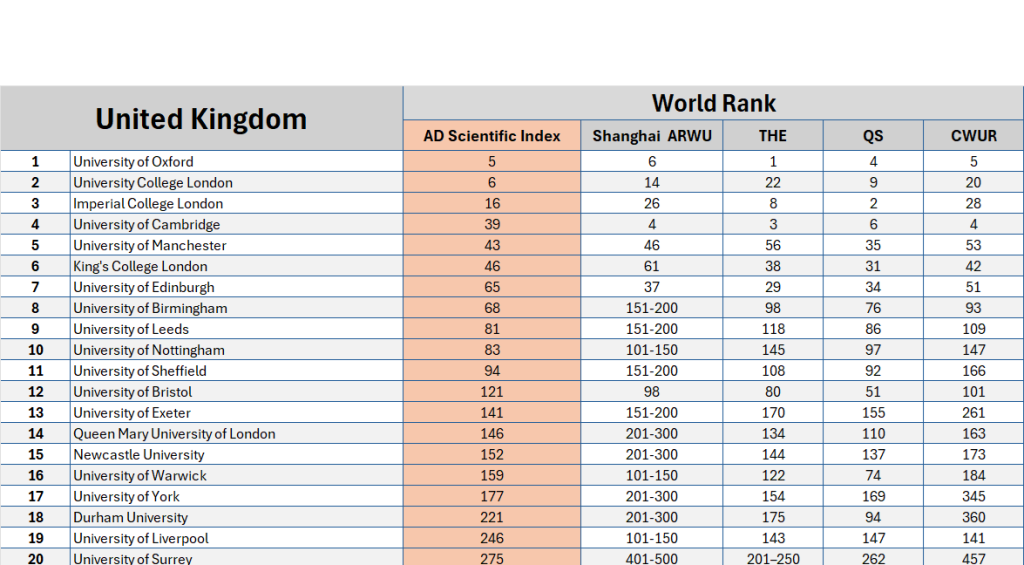
In the global landscape of university evaluations, systems such as ARWU (Shanghai), THE, QS, and CWUR have long contributed to recognizing academic performance and excellence worldwide.
Each of these established systems applies distinct methodologies, data sources, and indicator weightings, offering valuable but sometimes diverse perspectives on institutional achievement.
The AD Scientific Index, however, introduces a complementary and transparent approach designed to reflect academic reality from a different angle.
Instead of focusing solely on institutional-level data, it adopts a bottom-up, real-time model that begins with the performance of individual scientists.
This unique structure enables universities to gain a continuously updated and evidence-based understanding of their true academic impact and visibility.
🎯 A Distinctive, Data-Driven Approach
The AD Scientific Index goes beyond being just another ranking system — it functions as a comprehensive academic performance analysis platform.
Its foundation lies in real-time data drawn directly from the profiles of individual scientists, offering a transparent and measurable view of scientific productivity and influence.
Key strengths of the AD Scientific Index include:
- 🕒 Real-Time Academic Insights: Institutions can continuously monitor their research performance and progress.
- 🧠 Individual-Based Evaluation: Starting from the scientist level ensures fairness, accuracy, and clarity.
- 📊 SMART Institutional Excellence Plan: A strategic, data-driven roadmap for universities to enhance academic quality and global standing.
- 🌐 Global Comparability: Allows universities worldwide to benchmark themselves transparently and ethically.
- 💡 Integrity and Ethics: Helps promote responsible research by identifying irregularities such as citation manipulation or honorary authorship.
🇬🇧 The UK’s Academic Landscape Through the Lens of AD Scientific Index
In the United Kingdom, universities are globally recognized for their excellence, innovation, and research leadership.
The AD Scientific Index provides a more detailed and dynamic understanding of this excellence by highlighting how individual contributions shape the nation’s overall academic visibility.
While traditional systems may produce differing results based on their data sources (Google Scholar, Scopus, Web of Science) or weighting criteria, the AD Scientific Index offers a real-time, transparent, and ethically grounded framework.
It helps institutions identify their strongest contributors, monitor progress continuously, and implement strategies based on measurable academic evidence.
UK universities can benefit from:
- 📈 Improved visibility through transparent, real-time data,
- 🧩 Clear identification of leading researchers and departments,
- 🧠 Strategic insight for performance-based planning,
- 🏛️ Evidence-supported decision making to foster sustainable academic growth.
🌍 A Global Vision for Transparent Evaluation
Together with its SMART Institutional Excellence Plan, the AD Scientific Index provides universities and research institutions with a strategic, ethically responsible, and data-based framework for continuous improvement.
As competition in global academia grows, these tools empower institutional leaders to make informed decisions, enhance research visibility, and align their strategies with measurable academic impact.
This model not only strengthens institutional performance but also supports the broader goals of transparency, integrity, and collaboration within higher education.
💬 Discussion Points
1️⃣ How does the AD Scientific Index complement and enhance traditional university rankings?
2️⃣ What role does individual-level analysis play in improving transparency and strategic planning?
3️⃣ How can UK universities use the SMART Plan to advance their global visibility and research excellence?
🔗 Explore more: www.adscientificindex.com
📢 Suggested Hashtags:
#ADScientificIndex #SMARTPlan #AcademicTransparency #UKUniversities #UniversityRankings #ResearchImpact #HigherEducation #GlobalExcellence #AcademicIntegrity